
Kohberger, suspect in stabbing deaths of 4.
Definitions of Insanity.
There’ve been half a dozen insanity tests over time. One of the most famous was the M’Naughten test.
The M’Naughten insanity test.
If a truly insane person–say a paranoid-schizoid, heard voices in his head–he might kill even if a policeman were standing next to him, at his elbow. This was the classic test that got watered down over time in the U.S.
Of interest, when it comes to defining insanity, is that in 1968, a major U.S. ruling stated that legal insanity is different from medical insanity. The latter was defined as a persistent mental disorder or derangement.
The Model Penal Code insanity test.
As I note in my upcoming book Privileged Killers, the definition of legal insanity in America has been increasingly liberalized over the last hundred plus years.
According to the “Model Penal Code” at he end of the 20th Century, a judge was supposed to assess legal insanity this way:
- You’re legally insane if you don’t know that what you’re doing is wrong, or
- You’re legally insane if you cannot resist the impulse to do something seriously criminal.
This insanity test has both cognitive and willpower components. These two criteria, in my humble opinion as a criminologist, were the result of a clumsy attempt to lessen the rigidity of previous insanity tests.
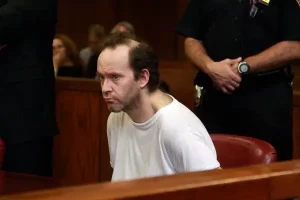
David Tarloff- failed insanity test.
Today’s insanity test situation.
Nowadays, judges and juries have few criteria beyond the two offered in the Model Penal Code to guide them in their deliberations other than their own sense of fairness. It’s hard as the David Tarloff case showed. A seeming schizophrenic, Tarloff brutally attacked a therapist in 2008 Manhattan. It took three trials to convict him of murder.
In reality, judges and juries tend to honor the side in court that presents the most persuasive psychiatric and/or psychological testimony. This, even if expert witnesses inaccurately claim that a defendant has a psychosis (e.g,, has schizoid splits from reality) when s/he only has a neurosis (e.g., has persistent fantasies).
Why play this insane courtroom game?
One theory I express in Privileged Killers (due out this year) is that participants play the “insanity” game in court because they fear the defendant will be irrevocably “labeled.” What defense attorneys want from an insanity hearing or verdict are self-labels (and public-labels) that are more easily alterable after incarceration.
Along these lines, defendants and their loved ones would rather the offender have “had a nervous breakdown” than have “done time for murder.” The stigma attached to the latter can be enormous
and difficult to overcome when re-entering society after release from prison.

Jack Nicholson – passed insanity test.
What about faking insanity?
Many of us know of the character Randle McMurphy (Mac) who fakes insanity in the 1975 movie based on Ken Kesey’s 1962 novel, One flew over the Cuckoo’s Nest: Jack Nicholson. As Mac, Nicholson fakes insanity in order to do easier time at a mental hospital than a prison farm. There have been cases of real bad guys who study psych books and fool shrinks, psychiatrists, who evaluate them.
And many of us can’t forget the “Son of Sam”– the scary serial killer, David Berkowitz– who terrorized New York City for over a year. He later claimed he faked his story about demons speaking to him through his neighbor’s dog, Sam.
What’s your take on all this?
My humorous response is: the real question is how we can fake being sane in this mad world so that our bosses don’t fire us or our romantic partners don’t leave us.
Seriously, though, leave me a comment below. Thanks.