Cleft lip kids discuss the darnedest things.
Ever discussed with a group of friends whether you’d give up a year of your life for a more perfect, symmetrical face? Unless you were born with a cleft lip,* you probably haven’t. For non-clefts, such a discussion may be akin to those silly debates over whether you’d rather burn to death or freeze to death. Still, the question does bring up our assumptions about perfection and symmetry as they relate to beauty. We often think that we have a best side and if it were just duplicated, we’d look more attractive, seductive, even sexier. Moreover—because facial symmetry has long been associated with youthfulness, health and even genetic fitness for procreation—we think we might even gain these traits, too.
Symmetry not always more beautiful.
However, as noted in a recent article, American fashion photographer Alex John Beck challenges the belief that balance is more beautiful, more seductive. In a series of portraits, Beck made symmetrical versions of the right and left sides of a model’s face, shown below. The result—and the contrasting characters that can exist in one face is startling.
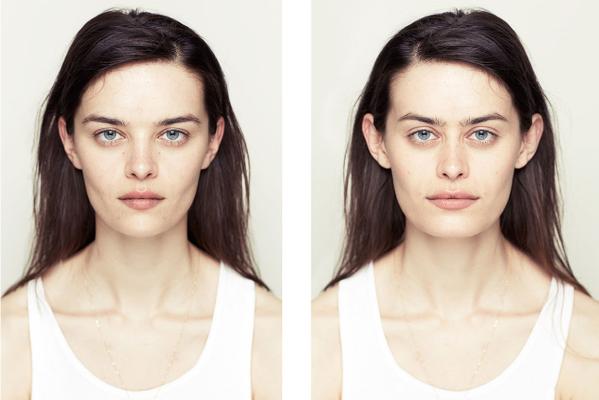
Duplicated images of the left and right sides. of the face challenge ideas that symmetry is more attractive. Beck.
In Beck’s own words,”We give weight to each side of the face, making two faces from one face, two faces from one moment, captured by one photograph.”
“The less symmetrical they are initially, the more different the characters suggested by each face. [See male model below.] The more symmetrical faces betray their owners more subtly…,Maybe a person who knows them in real life recognizes one portrait and not the other. Regardless, each is always present, though as a half, and each face is valid.

A more symmetrical face like this betrays it owners more subtly. Beck ’14.
Beck further explains, “So, when the owner of the face thinks they present an expression of positivity and openness, the other side has other ideas, frowning.”
But, asymmetry can equate to character and complexity and therefore be equally compelling, Beck argues.
Perhaps true beauty lies in between perfection and our peccadillos.
“I think they lack character – beauty is more based on character than an arbitrary data point,” Beck told Time which published several of his symmetrical portraits.
“Humanity is messy and should remain as such. I, for one, am not a fan of centre-parting [of hair], for example. And even the greatest tennis players favour one arm.”
He believes that seeing the left and right side-by-side in this way, instead of showing the original portrait as well, is revealing.
Our eyes can express incongruity in the way we feel, for instance.
“One side is completely present and alert and getting ready and interested, and the other side is half asleep,” he observes of a portrait.
Want to get in on the act?
In 2010, Australian photographer Julian Wolkenstein began a project similar to Beck’s, and he now runs a website and an app called Echoism where people can try out their own different sides for size.
“Echoism has had over 70,000 uploads since November 2011, when the app went live,” he says. “However, he points out that while he is thrilled by the response, the site is more “about questioning a beauty myth” than any attempt at a scientific thesis on beauty and perception.
“I am not commenting on the beauty of symmetry as such, more that we have a notion of our image and what happens when we abstract this – do we see ourselves differently?”
_______
*If you doubt that asymmetry is an issue for clefts, check out this admittedly complex abstract from a 2014 Journal of Oral Science article:
“Craniofacial morphology and asymmetry were compared before, during, and after puberty within and between patients with unilateral complete cleft lip and palate (UCCLP) and a non-cleft group. In the UCCLP group, the posterior cranial base and total cranial base were significantly shorter at all skeletal periods, the maxilla was significantly retruded and posteriorly rotated, and the mandible was significantly smaller and inferoposteriorly rotated. The angle between the nasal and mandibular plane and lower anterior facial height were significantly higher,and upper posterior facial height and total posterior height were significantly lower, in the UCCLP group.
Except for an increase in the nasal cavity, no significant differences were detected in facial width. For all measurements, asymmetry on the horizontal plane was more significant than that on the vertical plane. Asymmetries in the UCCLP group were mostly detected during puberty. The UCCLP group had no distinctive mandibular asymmetry, as compared with the Class I group. In UCCLP patients, the cranial base, maxilla, and mandible were affected on the sagittal plane during all growth periods. However, horizontal asymmetries were mostly detected before and during puberty. Vertical asymmetries were less severe, and there was no distinctive mandibular asymmetry as the control group.”
My latest book, PRIVILEGED KILLERS, is a true story about a half-dozen Dark Triad people in my everyday life - narcissists, manipulators, and psychopaths. Three of 'em murdered people, and one came after my wife and me. Print and e-book versions of this (and CLEFT HEART) available at Amazon and elsewhere online. Also at your local bookstore.
Leave a Reply